

Software engineer at AT-Automation: John on 5 years of growth & international projects in Weert

In this article
When John, 27, started at AT-Automation as a Software Engineer five years ago, he was literally on the shop floor. As a PLC engineer, he worked directly in the factory, operating the machines. What he didn’t know at the time was that his career would take an unexpected turn within a few months. He would go on to connect the office network with the production floor and now plays a key role in international projects
Instead of operating the machines, he now extracts data. “I take data from a production line and turn it into clear dashboards, so that insights from that data are presented in a visual and understandable way,” John summarizes his current work as an Ignition Software Engineer. This is his story about the company’s growth, his own development, and why, after five years, he still enjoys working in Weert.
Master Your Growth at AT-Automation: From PLC Engineer to Medior Software Engineer
John started at AT-Automation as a PLC engineer but soon realized that his interest lay more in the data and process side of the factory. Instead of just programming machine lines, he wanted insight into the flow of information and how systems interact. Ignition was a perfect fit: its way of thinking and programming matched what he had learned in his studies. He also appreciates not being constantly on the shop floor, but instead working on solutions that support the entire factory. Over time, he increasingly moved toward the Ignition side of things – now the majority of his work.
Ignition is the software AT-Automation uses to extract data from machines, send orders to the machines, and create the link between the office environment (the ERP system with sales orders) and the production floor. It is the core of the information flow.
This shift was a deliberate step. John had the freedom to do so Within two years, he progressed from PLC Engineer to Ignition Software Engineer. Nowadays, he is transitioning to Senior Developer. This means his focus is shifting from purely writing code to a broader role.
“The opportunities I’m getting now involve being part of the sales process, handling some project management, and guiding and mentoring people,” John explains. “Instead of just taking on tasks, I manage the entire project. I’m involved in the initial client meeting, set up the research, and outline the tasks for a fellow engineer.”
“The growth in responsibilities goes hand in hand with a healthy balance for John. He explains: “My role means I am responsible for a successful delivery. That sometimes means I work a bit longer, for example, to ensure that an application can be properly put into operation or so that testing can start immediately on the shop floor the next morning. But that responsibility works both ways: if the work allows, I can also finish an hour earlier. That way, my work-life balance feels very natural and well-balanced.”
To compensate the office-based nature of the job, John works out four times a week. He’s been active in the lifeguard association for fifteen years and also competes in swimming. This physical activity gives him the energy he needs for his work as a Software Engineer.
That focus on staying active is actually a team effort: the team goes outside twice a day for a short walk. Getting some movement, getting a breath of fresh air, and gaining a fresh perspective on complex challenges. Because sometimes the best answer isn’t found in the code, but in the fresh air!
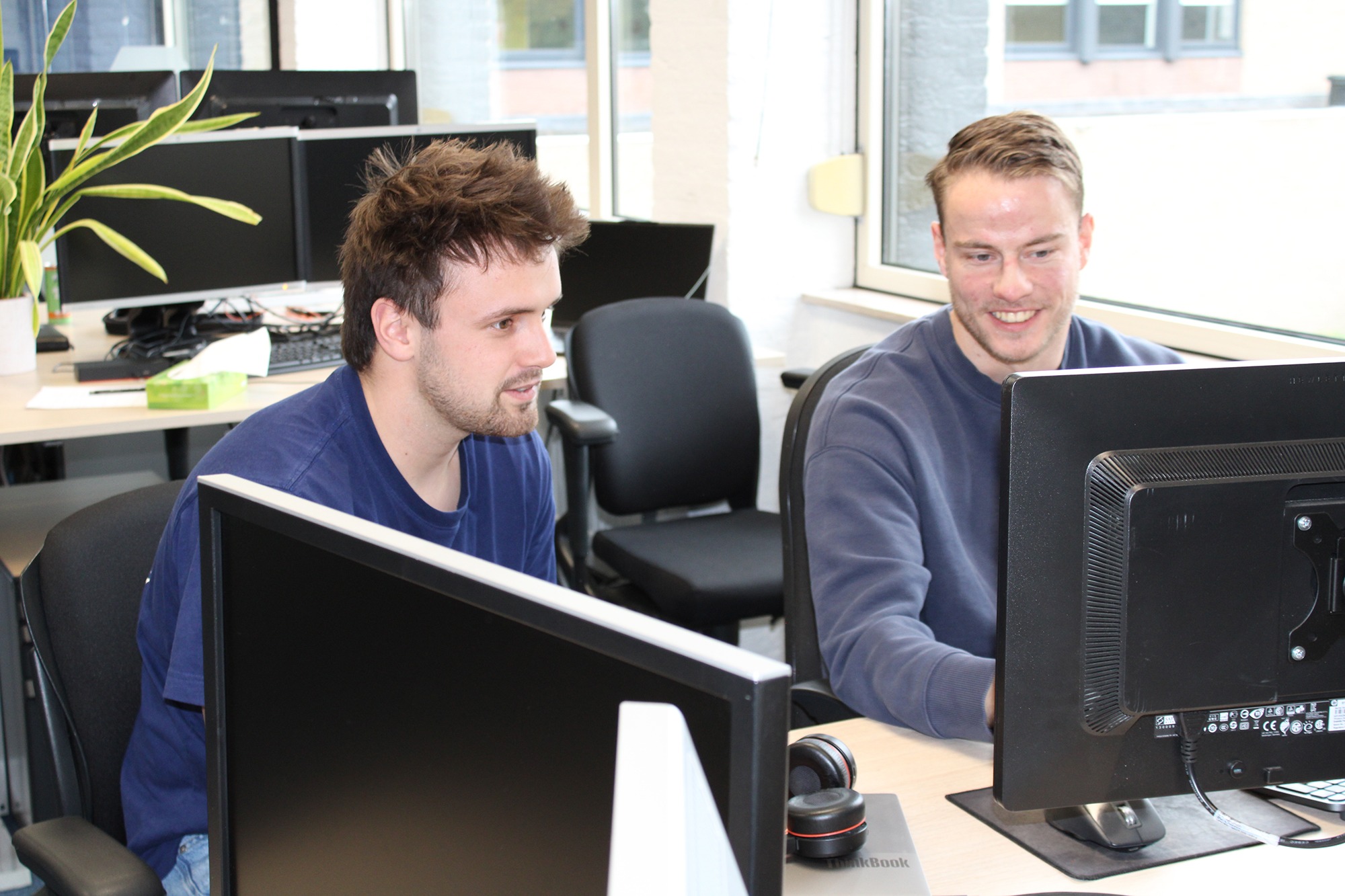
Team Dynamics: Collaborating with Young Software Engineers at the Weert Office
What John values most at AT-Automation is the team’s dynamic and the opportunity to make mistakes-and figure things out on his own.
When people walk in here, they quickly notice that we have a young and dynamic team. The average age is around 30. That’s good if you’re young yourself, then you have a nice team.
At AT-Automation, the team shares its knowledge freely. Working independently is important, but you are never alone. “In the beginning, I was allowed to figure out a lot of things for myself and take on tasks independently,” says John. “But if you get stuck, the team is always there to help. You often get an immediate response, or someone refers you to a colleague who has previous experience with the issue. That way, you learn continuously and together.”
This approach accelerates development. John now has the knowledge to help his teammates more quickly. “Now it’s more that if I’ve encountered a problem myself before, I immediately know what the solution is. That way, my teammates don’t have to spend so much time searching for the answer.”
In addition to daily collaboration, team outings and joint drinks ensure a good atmosphere. “Young colleagues who are fun to talk to. You’re kind of in the same stage of life. Coffee beans are always available, and they’re delicious too. Ending the week with a beer on Friday afternoon is fun.”
Projects: From Local Excel to Global SCADA and MES at AT-Automation
The complexity of the projects has grown enormously in five years. What began as local assignments are now often international challenges.
John recalls one project with pride: “We started with one line at a customer’s site, purely and simply extracting data. They had many different Excel files. But that has now been rolled out to control the entire factory. We have taken over order planning, right down to scheduling the trucks that come to collect the parcels.
The advantage for the customer is clear: data is immediately available, instead of someone having to search through a three-week-old Excel sheet. This enables faster and better decisions to be made, which benefits both the quantity and quality of production.
When I started working, this was one of the larger projects. I am pleased with how things turned out.
International customers add an extra layer to the work. “That’s the most challenging thing with some customers: that they really are going to be working across multiple factories in multiple countries,” John notes. “Not only does this involve cultural differences, but we also have to take into account the machinery and the objectives and ambitions of each factory, which can vary considerably.”
It is precisely because of its complexity that the work remains varied. “Usually, every customer is different. The problems that one customer has are sometimes simply not present for another customer, and for another customer, it is precisely a major problem that they are trying to solve.”
To gain a real understanding of what the customer needs, John regularly visits them: “It’s necessary to gain insight into what you’re working with. You can ask specific questions and identify any problems. I love that the job offers flexibility: I don’t have to travel constantly, but a few trips a year fit perfectly with my work-life balance.
The Future: Growth in Seniority and Technical Leadership
In five years’ time, John still sees himself growing within AT-Automation. The line is clear: he wants to continue developing himself as a software engineer.
He will be given plenty of opportunity to do so. For him, that growth lies in broadening his impact: “Ultimately, I want to take on a more advisory role towards clients, in which I will also be responsible for part of the project management.”
This requires technical leadership. John wants to maintain an overview as the projects become more complex. “That means I provide direction to the project team of four or five people who are working on implementing the solution,” he explains.
His story shows how AT-Automation gives you the opportunity to chart your own course. The shift from PLC to Ignition, ultimately progressing to a senior role with technical leadership and mentoring responsibilities, and working on international projects. All this in an ambitious team, just a 15-minute drive from home.
Would you also like to work in a team where your growth really matters and you get the opportunity to grow as a software engineer? Then take a look at our current vacancies.
In this article
Stay up to date
Receive our monthly newsletter in your inbox.
Or follow us
Share this article
You might also like
Control Engineering at AT-Automation: The vision of team leader Jack Vonken
Jack Vonken (Team leader Control Engineering) shares his vision on industrial automation at AT-Automation: “We aim for the long term with solutions that truly work.”
AT-Automation B.V. acquires Van Daal Engineering
Weert, September 1, 2025 – AT-Automation B.V., a leading industrial automation company with two locations in Weert, announces the acquisition of Van Daal Engineering, effective September 1st, 2025. With this strategic acquisition, AT-Automation strengthens its...
Time to revise or replace your PLC? Use the decision tree
A PLC is a crucial component of many industrial processes. However, like any technology, a PLC has a lifespan, and sooner or later, the question arises: should we revise or replace it? Use this decision tree…