


Unified Namespace (UNS):
the data layer that enables
Industry 4.0
In this article
- What is a UNS and why is it important?
- The role of UNS in Industry 4.0
- UNS and OPC UA: why this combination is the standard
- Why Ignition is the ideal engine for your UNS
- Real-time data and Predictive maintenance
- Smart Industry in practice: The UNS success story at BMT Aerospace
- Technical guide: AT-Automation’s UNS approach
- The future of smart factories with UNS
- Ready for the next step?
In the modern IIoT landscape, everything revolves around data. However, in practice, we see a persistent problem: data is trapped in silos. These are separate systems—from the PLC on the shop floor to the ERP package in the office—that hardly communicate with each other, if at all. This fragmentation hinders real-time insight, slows down innovation, and makes the necessary Digital Transformation a complex and extremely expensive process.
A Unified Namespace (UNS) with Ignition as a central platform offers the solution to this fundamental problem. It is the architecture that creates a central, hierarchical, and real-time data layer where machine and application data converge. With a UNS providing a structure to achieve this, you transform your factory into a flexible, connected, and data-driven organization.
What you need to know about UNS
What is a Unified Namespace? A central software concept that organizes all industrial data (OT and IT) into a single logical structure.
What is the role of Ignition? Ignition acts as the central hub (MQTT Broker/Gateway) that collects and publishes data to the UNS.
Why ISA-95? This standard provides the hierarchical context (from Enterprise to Tag) that makes data understandable for both the Automation Engineer on the floor and the IT manager in the office.
Key benefit: It eliminates data silos and point-to-point connections through a ‘decoupled’ architecture.
What is a Unified Namespace and why is it important?
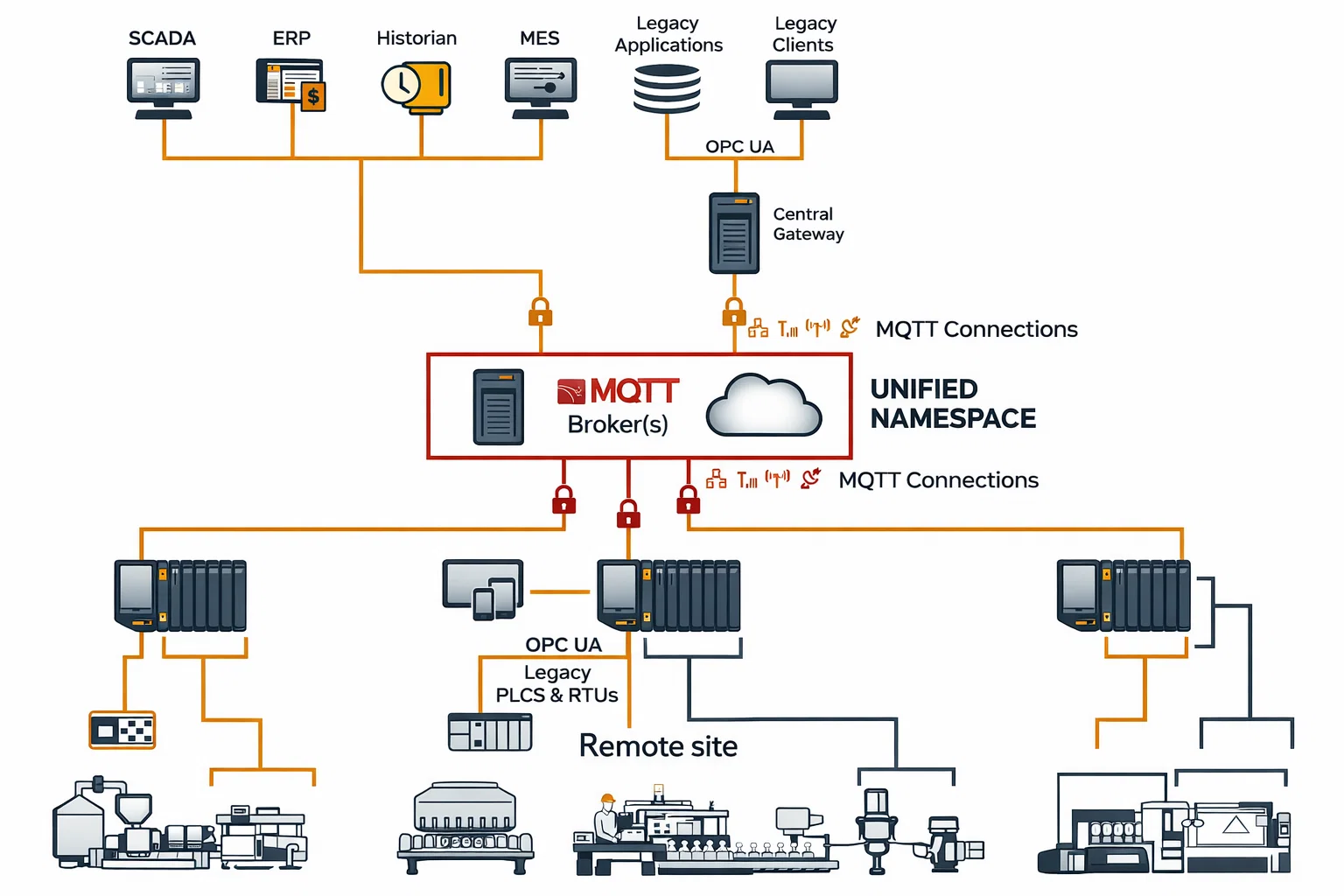
A Unified Namespace is not a “package” you buy, but a concept. It brings data from machines, PLCs, sensors, SCADA, MES, and ERP together into a single standardized structure.
In a traditional factory, you often see a web of point-to-point connections. If system A needs data from system B, a specific connection is built. With ten systems, this quickly becomes unmanageable. In a UNS architecture, systems publish their data to a central “hub” and other systems only consume what they need at that moment.
UNS als Single Source of Truth (SSOT): Key features
- Single Source of Truth: All real-time data is uniform and centrally available. There is no longer any debate about which value is correct; the UNS is the only source.
- Decoupling of Systems: Systems do not need to integrate directly with each other. This means you can replace a machine or software package without disrupting the rest of the infrastructure.
- Hierarchical Data Layer (ISA-95): Data is not collected as an unstructured heap but organized according to a logical structure. We use the ISA-95 hierarchy as a strong foundation. This means every data point immediately has context (e.g., Enterprise/Site/Area/Line/Cell/Tag). An analyst in the office can instantly understand that a particular temperature reading belongs to ‘Oven 1’ on ‘Line 3’ in the factory in ‘Eindhoven’. While we use the ISA-95 hierarchy as a base, no two factories are the same. We adapt the data structure flexibly to your specific practices and requirements so that the technology follows the operation-and not the other way around.
The role of UNS in Industry 4.0
Industry 4.0 is about connectivity, real-time interoperability between systems, and smart data insights that can make autonomous decisions. UNS forms the crucial link that definitively closes the gap between IT and OT (Operational Technology):
✔ IT/OT convergence OT data (from the shop floor) becomes directly accessible to IT systems in an understandable format.
✔ Real-time data sharing It supports dashboards and analyses that do not look at yesterday’s data, but at what is happening right now.
✔ Unlocking new technologies Without a UNS, implementing AI-driven analytics, Digital Twins, or complex IoT applications is nearly impossible because data preparation takes too much time. In a UNS environment, the data is already available ‘clean’ and structured for these models.
Unlike traditional, hard-coupled integrations, a UNS ensures that data is made available flexibly and scalably to all stakeholders – from the operator on the line to the management in the boardroom.
UNS en OPC UA: Why this combination is the standard
Although a UNS is technology-neutral, in practice it is often built on an MQTT publish/subscribe architecture. In this setup, the MQTT broker serves as the central data bus, while protocols such as OPC UA are used to securely and structurally retrieve data from the underlying assets and expose it to the UNS.
✔ OPC UA provides structured, semantic data and secure access to machine and sensor information.
✔ MQTT/Sparkplug B enables scalable, decoupled real-time data distribution.
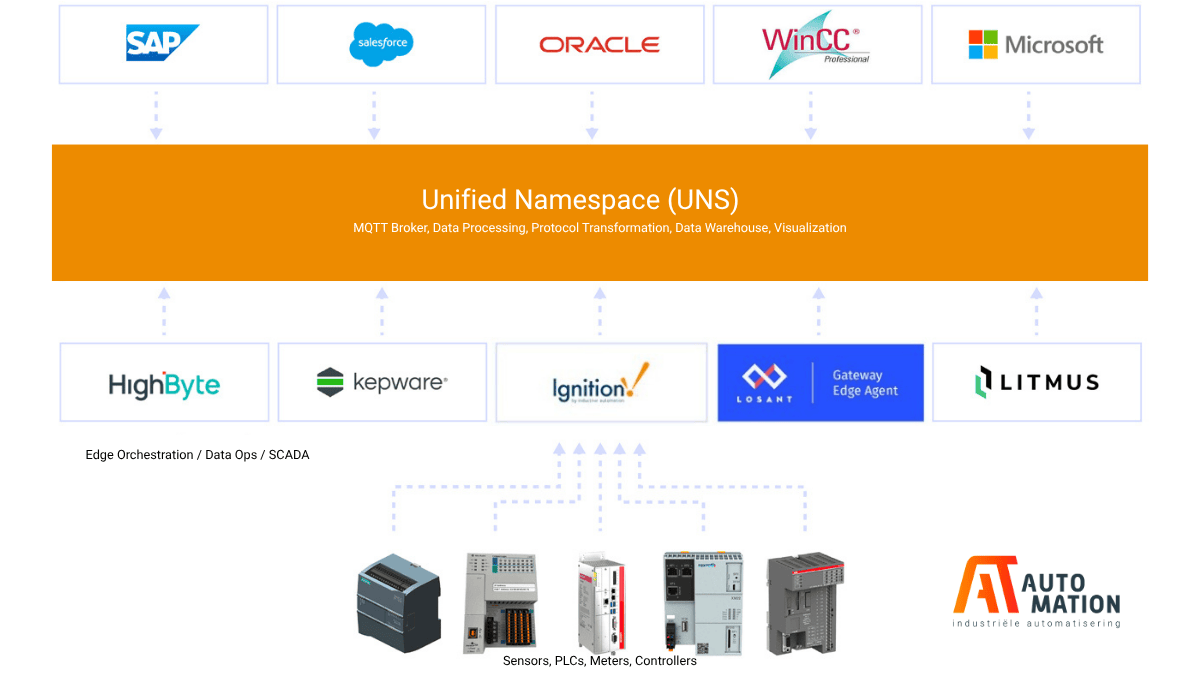
In a modern UNS architecture, OPC UA delivers the rich, contextual data from the shop floor, which is then published into the Unified Namespace via an Ignition gateway using MQTT.
Why Ignition is the ideal engine for your UNS
Ignition serves as the beating heart of the UNS architecture. As a Premier Ignition Integrator, we see every day how this platform bridges the gap between the physical shop floor and the digital strategy:
Universal data access: It retrieves real-time data from PLCs, SCADA systems, and sensors via roughly 15 directly available drivers. This number can be further expanded through additional software.
Contextualization via Sparkplug B: Raw data is transformed in Ignition into meaningful information and immediately published into the correct namespace.
Accessibility: Once the data is exposed in the UNS, this architecture makes it instantly available to external applications, AI models, Digital Twins, and BI dashboards (such as Power BI or Tableau).
Realtime Data & Predictive Maintenance
One of the greatest added values of a Unified Namespace is the immediate applicability of data for maintenance strategies. In a traditional setup, sensor data is often only visible locally on an HMI screen. With a UNS, this data flows in real time to analysis tools.
Practical applications:
✔ Real-time dashboards: Ignition provides global insight into OEE performance. By structuring data through the UNS, this can be scaled directly to other BI tools and analytics models, without the need for additional integrations for each new application.
✔ Predictive Maintenance: Algorithms combine real-time UNS data with historical patterns from the Historian to predict failures before downtime occurs.
✔ Flexible MES/ERP integrations: Inventory levels and production counts are automatically updated without manual input, as the ERP system ‘listens’ to changes in the UNS.
Smart Industry in practice: The UNS success story at
BMT Aerospace
Our collaboration with BMT Aerospace demonstrates this in action. Here, AT-Automation implemented a UNS architecture with Ignition as the beating heart, supported by standards such as MQTT and OPC UA. By replacing fragmented data silos with a single central source, BMT Aerospace immediately realized measurable benefits:
✔ Standardization: Data from machines, PLCs, and sensors is now uniformly available.
✔ Real-time insight: Immediate monitoring for both operators and management.
✔ Future-proof: A solid foundation for scalable process analytics.
International Recognition & Technical Depth
That this approach is world-class is evidenced by its inclusion in the prestigious Ignition Discover Gallery 2025. This international recognition highlights the innovative strength of the chosen architecture.
If you want to dive deeper into the technology, there are two ways:
✔ Ignition Discover Gallery Case Study: Watch the short, impressive presentation in the video above.
✔ AT-Automation Webinar (BMT Aerospace): In the webinar below, Bart Mans (AT-Automation) and Koenraad Lievens (BMT Aerospace) go in-depth, discussing the practical integration of MQTT and OPC UA within a complex, international production environment.
Technical Guide: The UNS approach of AT-Automation
Implementing a Unified Namespace is not a one-time installation, but a process of digital transformation. At AT-Automation, we follow a proven approach to guide factories step by step toward Industry 4.0.
1. The Industrial IoT Maturity Model
Before we start, we assess where the organization stands in the maturity model. The journey toward maximum value unfolds in two main phases:
Digitalisation: We begin with Computerisation (making data digital) and Connectivity (linking systems together).
Industry 4.0: Once the foundation is in place, we progress to Visibility (seeing what is happening), Transparency (understanding why it happens), Predictive Capacity (forecasting what will happen), and ultimately Adaptability (systems that optimize themselves).
2. Project Approach: From Transformation to Standardization
To successfully follow this model, we break the project into a clear roadmap:
Phase A: Transformation (The Foundation)
- Orientate: Define scope and objectives.
- Test (Pilot): Prove the value on a small scale.
- Scale Test: Verify whether the architecture is robust enough for larger data volumes.
- Standardize: Establish an enterprise-minded approach with a long-term focus.
Phase B: Standardization (The 10 Steps to Success)
Once the pilot succeeds, we roll out the UNS architecture broadly using a fixed step-by-step plan:
- Connect & Transform: Integrate both new (greenfield) and existing (brownfield) systems.
- Collect & Store: Centrally gather data in the UNS and securely store it in a Historian.
- Analyze & Visualize: Convert raw data into understandable insights and real-time dashboards.
- Find Patterns & Report: Identify trends and automatically share them with the right stakeholders.
- Solve: The ultimate step: use data proactively to resolve issues and improve processes.
Best Practice: The Hierarchical Structure
Central to this approach is naming according to the ISA-95 standard. By organizing data from Enterprise down to Tag level, we create a logical ‘tree structure.’ This allows applications to access data without needing to know how to communicate with a machine – only where the data resides in the UNS.
The future of smart factories with UNS
The Unified Namespace is not the end goal, but the foundation. It forms the basis for the factory of tomorrow: an ecosystem where data is not just reported, but actively utilized for autonomous decisions and adaptive production processes.
With a Unified Namespace, industrial data becomes available centrally and in a standardized manner. This forms a strong basis for applications such as AI-driven process optimization and Digital Twins, allowing data to play a strategic role in continuous innovation.
Ready for the next step?
The transition to a Unified Namespace is a strategic choice. This requires internal support and external expertise at the intersection of technology and process management. As a Premier Ignition Integrator, AT-Automation supports you in the necessary steps.
Schedule a non-binding appointment today to take the first step!
In this article
- What is a UNS and why is it important?
- The role of UNS in Industry 4.0
- UNS and OPC UA: why this combination is the standard
- Why Ignition is the ideal engine for your UNS
- Real-time data and Predictive maintenance
- Smart Industry in practice: The UNS success story at BMT Aerospace
- Technical guide: AT-Automation’s UNS approach
- The future of smart factories with UNS
- Ready for the next step?
Stay up to date
Receive our monthly newsletter in your inbox.
Or follow us
What is a Unified Namespace (UNS)?
A central software concept that organizes all industrial data (OT and IT) into a single logical, real-time data layer.
What role does Ignition play in a UNS?
Ignition acts as the central hub (MQTT Broker/Gateway) that collects, contextualizes, and publishes data to the UNS.
Why is the ISA-95 standard used?
This standard provides a hierarchical structure (from Enterprise to Tag) that makes data immediately understandable and usable for both humans and machines.

Ready to Master
your growth?
Ready for a scalable factory? Discover how a Unified Namespace connects your IT and OT. Fill in the form for a non-binding consultation or a custom demo.
Share this article
You might also like
How can Ignition MES truly improve your OEE and reduce downtime?
Ignition MES from AT-Automation provides real-time insight into production, improves OEE, reduces downtime, and makes maintenance proactive.

Software Engineer at AT-Automation: John on growth and international projects in Weert
John Meerten (27), who started as a PLC engineer on the shop floor, took an unexpected turn to become a Software Engineer at AT-Automation. Read how he now connects clients’ office networks with the production floor and manages international projects.
AT-Automation B.V. acquires Van Daal Engineering
Weert, September 1, 2025 – AT-Automation B.V., a leading industrial automation company with two locations in Weert, announces the acquisition of Van Daal Engineering, effective September 1st, 2025. With this strategic acquisition, AT-Automation strengthens its...