


Project Overview
Safe loading through smart process orchestration
Tessenderlo Group wanted to make the loading process safer, more consistent, and less dependent on manual operator actions. AT-Automation developed a Safe Loading application in Ignition for this purpose. Drivers independently start their loading process via a QR code and are guided step-by-step through validations, safety checks, and the actual loading. Thanks to SFC-based process orchestration and a modular architecture, a standardized solution was created that not only works at a single loading point but is scalable to multiple installations and locations.

Project for
Tessenderlo Group is an international industrial group active in sectors including agriculture, bio-residuals, and industrial solutions. Within the production and logistics environment, complex processes, high safety requirements, and various IT and OT systems converge.
For loading processes, this means that not only are speed and availability important, but above all, that every step is performed safely, in a controlled manner, and is reproducible. At the same time, a solution must be able to grow with multiple loading points and production sites. More about Tessenderlo Group:
PROJECT CHALLENGE
The loading process at Tessenderlo Group was heavily dependent on manual interaction between operators and various systems. Orders came from the IT environment, while operators had to prepare and start the actual execution within the DCS. Consequently, process knowledge and operator availability were key factors in daily operations.
Tessenderlo Group wanted to enable drivers to perform the loading process independently, without compromising on safety and process control. This meant that validations, safety checks, and process steps could no longer depend on individual working methods but had to be structurally enforced by the system.
At the same time, the existing process control in the DCS could not be unnecessarily modified. The challenge for AT-Automation was therefore to create a user-friendly and reliable workflow on top of the existing OT layer that connects IT, logistics, and process control.
Ensuring safety: Every loading cycle must go through the same safety checks.
Simplifying complexity: A driver must be able to perform the process without knowledge of the underlying control system.
Scalable design: The solution must be easily applicable to new loading points and locations.
Solution
AT-Automation developed a Safe Loading application in which Ignition acts as a central orchestration layer between the logistics systems and the existing DCS.
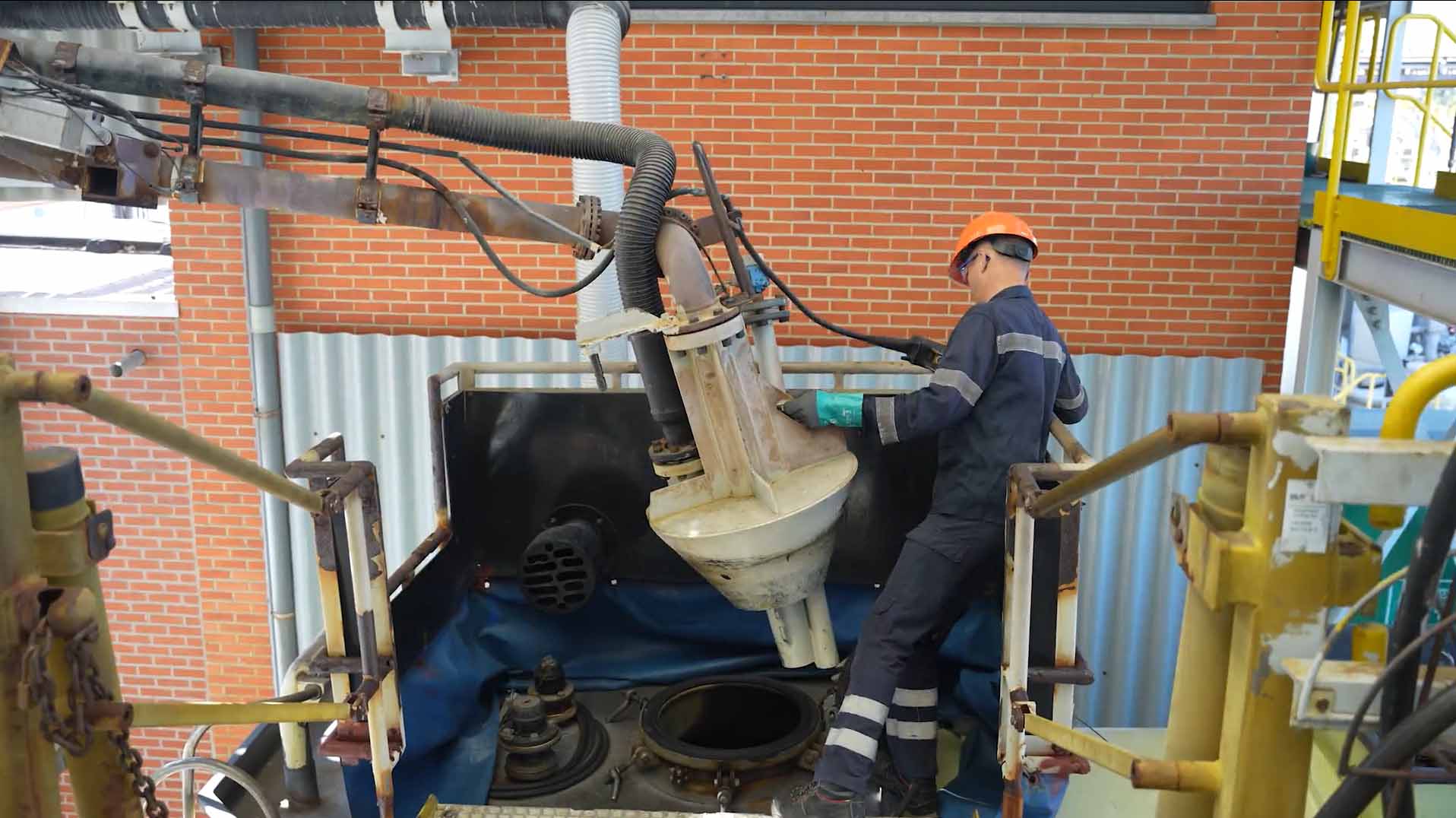
The driver starts the process by scanning a QR code with loading data from LISA (YMS). Based on this information, the application assembles the correct loading workflow. The system then guides the driver step-by-step through order validation, safety checks, physical preparation, connection, and execution of the loading process.
The existing process control remains in the DCS. Ignition determines which steps can be performed and when, and monitors the progress of the entire workflow.
View the case | Safe Loading at Tessenderlo Group in action:
From QR scan to controlled execution
1. Scan the QR code
The loading order and associated data are automatically retrieved.
2. Start correct workflow
The application configures the loading procedure and performs all required checks.
3. Execute in controlled manner
The driver is guided step-by-step through the safe loading process.
SFC as engine behind
the workflow
The entire process flow is built using Ignition Sequential Function Charts (SFC). Each loading cycle runs as a separate workflow with clearly defined steps, conditions, and transitions. This allows multiple loading processes to be executed in parallel, while each process instance remains individually tracked and controlled.
Furthermore, the SFC architecture supports the controlled pausing, resuming, and recovery of workflows, so that deviations within each process instance can also be handled in a structured manner.
By modeling process logic visually and structurally instead of building it from complex scripts, the solution remains clear, maintainable, and expandable.
TECHNICAL PRINCIPLES
Modular ISA-95 structure
Loading bays, loading points, and loading arms are built as reusable objects.
Reusable workflows
The same SFC architecture forms the basis for different loading processes.
Hub & Spoke architecture
Central functionality can be combined with local execution.
Ready for further rollout
New loading points and locations can be added with limited additional engineering.
PROJECT IN FIGURES
246.700
Tags
20
Dynamic screens
6
Devices
4TB
Historical data
Result
Independent execution:
Drivers can perform the loading process independently, without requiring an operator for every step.
Safety built into the workflow:
Mandatory checks and conditions are part of the process and cannot simply be skipped.
Same working method for every loading cycle:
The system enforces a fixed, validated sequence and reduces differences between users and loading points.
Less technical complexity for the user:
The underlying DCS, IT, and process logic are translated into clear instructions and decision points.
Basis for further rollout:
The combination of reusable workflows and modular objects forms a standardized basis for rollout to multiple locations, without having to redevelop the core logic.
Partnership in practice
“Drivers can now be guided through the loading process independently, while we know for certain that the necessary safety checks remain part of every loading cycle.”
Thomas Aps, Tessenderlo Group Lead Process Engineer
“By decoupling the workflow from the underlying process control, we have built a solution that not only works for this installation but can serve as a basis for future loading points.”
Jelle Verstappen, AT-Automation Software Engineer
Project Experts
A multidisciplinary team from AT-Automation worked closely with Tessenderlo Group on the development of the Safe Loading application. Drawing from various areas of expertise and roles, the solution was developed in phases, validated, and aligned with operational practice.
Thomas Aps
Tessenderlo Group
Operational Technology Lead, Process Automation
Ensured the alignment between the technical solution, operational processes, and requirements from Tessenderlo Group.
Max van de Rijt
AT-Automation
Software Engineer
Worked on configuration, data processing, and supporting components within the Ignition application.
Bart Mans
AT-Automation
Project startup & architecture. 10+ years of Ignition experience
Translated functional requirements into the software architecture and laid the technical foundation for the solution.
Jelle Verstappen
AT-Automation
Lead Software Engineer
Responsible for the development of the Safe Loading workflows and the SFC-based process logic.

Ready to master your growth?
Do you want to standardize production processes, bring together information from OT and IT, and automate scalably without becoming dependent on closed platforms? Discuss with us the possibilities for helping your organization grow with full control over your processes and data.